
Heat Pumps
a greener alternative to a traditional boiler…
The pressure is on to find more eco-friendly ways to fuel the heating and hot water systems in our homes. New gas boilers are set to be banned from the 2035 & no newly built homes will be connected to the gas network from 2025.
A key eco alternative will be to install an electric heat pump to run our central heating system so we asked a couple of experts about the two main types: air and ground source heat pumps. We asked how do they work, which type of property do they work in, how much you could spend or save on heating costs, and what are the pros and cons?
So how do they work?
Heat pumps sound new but we are already using the same technology in our fridges.
A heat pump works in the same way, but in reverse. A fridge moves heat from inside the box to outside the box, the heat pump moves the heat from outside the box into it – the box being a house. It doesn’t create heat, it just moves it from one place to another turning it into a more usable form.
Heat energy is extracted from the air, ground or water and used to heat radiators & supply hot water.
Air source v heat pumps?
Air source heat pumps have a fan drawing in ambient air from outside the house, which heats a refrigerant within the heat pump. This is then compressed creating a high temperature, which is transferred to the water in the heating system & then on to the radiators in the property.
This type of pump is installed on the exterior wall or roof of your home, or can stand alone – the boxes can look a little like an air conditioning unit. They vary in size depending on the power needed. They can fit under a window outside a property or even be installed on a balcony. They are usually very quiet.
What do they look like?
The components that sit inside and outside air source pumps are already changing and improving. New models coming out are sleeker and even winning design awards. They can also be mounted in a louvred box & there are many ways to screen them
What is a ground source heat pump?
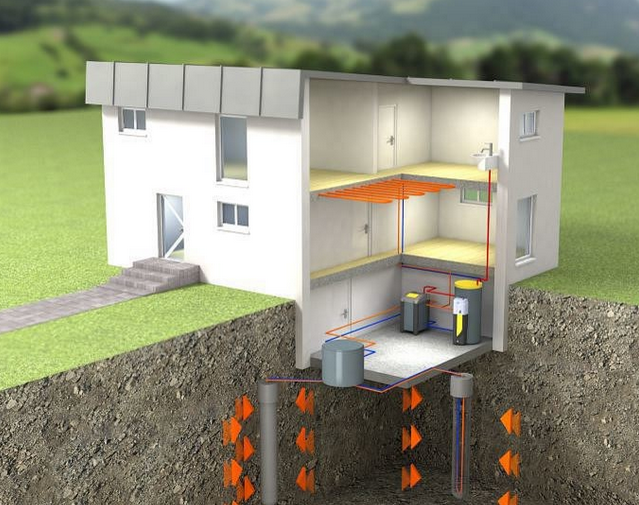
This type of pump extracts heat energy from the ground. It requires a large amount of outside space for the ‘ground arrays’ that are buried under the earth.
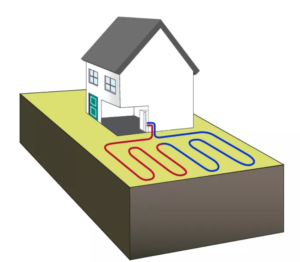
A ground array consists of a series of pipes installed between 1.5m and 3m underground. The pipes absorb thermal energy from the ground. The installation requires digging trenches but the finished installation will not be noticeable as turf can be replaced or the lawn reseeded once completed. Ground source heat pumps look similar to a freestanding fridge when installed in a property
How much do heat pumps cost?
Heat pumps cost more than a traditional boiler but it varies. The average air source heat pump will cost between £8,000 and £14,000, according to the Energy Saving Trust. A new gas boiler with thermostatic radiator valves costs around £2,300.
Ground source heat pumps are even more expensive because of the ground loops that need installing.
In time prices are likely to drop considerably as heat pumps become a more mainstream choice & house owners can expect to recoup costs through lower bills.
Will I need a hot-water tank?
You will need space inside the property for a hot-water cylinder & possibly a small buffer tank too.
Nearly 70% of gas-heated homes in the UK got rid of water tanks in recent years & installed combi boilers! If you’re short on space this is going to be a problem but engineers are working on ways to provide pumps without water tanks, so the space issue may be solved soon.
Which type of heat pump is suitable for my house?
Air source heat pumps are the most common type, because they’re suitable for most properties. They use minimal space in comparison with ground source pumps, making them suitable for even the smallest flats and terraced houses.
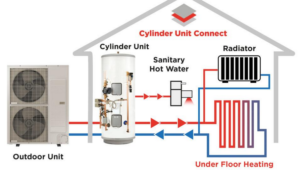
Air source pumps are cheaper, quicker and easier to install. They are not difficult to retrofit or use in new builds.
A ground source pump requires a great deal of space outside, and involves major disruption during the installation. It might be a better option if you are building your own property or having a massive overhaul.
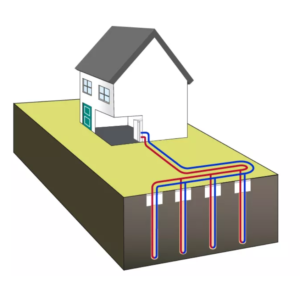
Ground source pumps come in two forms – vertical or horizontal loops. With a vertical loop, you use a piling machine to drill a deep hole. These are more resilient to sub-ambient freezing, but require specialist equipment. The horizontal system is like a trench dug out to 1.5m to 2m.
Borehole systems are better suited to properties that have limited land space and aren’t suitable for a ground array. Boreholes are created by drilling a hole up to 100m deep into the ground. The amount of ground loop required depends on the amount of heat energy you need to take from the ground, but once you get past 12m, the ground temperature is stable. The greater the heating demand of the property, the more ground loop will be required
Are there advantages?
The most important benefit of a heat pump is that they have zero emissions at the point of use, so homeowners can reduce their carbon footprint. Currently 31% of emissions from the home come from heating.
Pumps can be extremely energy efficient so ought to lower your future heating bills. The heat pump’s efficiency is called a COP, “coefficient of performance”. SCOPS (seasonal coefficients of performance) are better for ground source pumps than air pumps, if designed properly.
Electricity is used to power the heat pump. For every 1 kilowatt of electricity used by the heat pump, the property gets up to 5 kilowatts of heat in return
Heat pumps need less maintenance than a boiler & they pose no danger of carbon monoxide poisoning. A ground pump removes the need for fuel to be delivered and stored, which is common in homes that are in off-grid areas, where many households rely on oil.
Are there any challenges?
A house may need to be upgraded before it’s suitable for a heat pump. A house must be well insulated and airtight, with no gaps. It is thought that 80% of the homes in the UK are not really suitable. If you are refurbishing & renovating a house that is the time to consider installing a heat pump
Heat pumps can struggle to achieve the same temperatures as traditional gas boilers so you will probably have to increase your radiator sizes.
It is crucial to have an accurate design that relates to the specifics of your home. All these systems are tested under controlled situations so replicating those test scenarios in a house is difficult
Comparison of UK systems
| Heating Method | Average Annual Cost of Heating |
| Ground Source Heat Pump | £400 |
| Air Source Heat Pump | £600 |
| Biomass | £670 |
| Biomass | £750 |
| Oil | £900 |
| LPG | 1150 |
| Electricity | £1700 |
Have you considered a heat pump? What are your thoughts?


