
How to Choose a Shower Tray
Stand alone shower trays come in a great range of shapes and materials so choosing one can be a challenge. The main things to consider are the structure of the floor & the size of the room. Then consider whether this is for your forever home where you might spend more or is this going to be a budget decision for a renovation that you are going to sell on at a profit?
What shower tray types are available?
There are two main designs: low-profile and raised shower trays.
Low-profile versions are aesthetically more appealing and less of a trip hazard. They generally come in thicknesses of 3cm – 4cm, but some can be as slim as 2cm. These are laid above floor tiles making a tiny step the thickness of the tray or they could be inlaid & flush with the tiles creating a seamless floor level.
If there is no space for the pipework to be set into the floor, a raised shower tray would be the best solution, as they allow for raised pipework.
Raised shower trays can also be installed using adjustable legs, which gives more space for pipework & are useful for levelling uneven surfaces. The void underneath also allows easy access for pipework maintenance in the future.
What shapes are available?
There are many shapes available… square, rectangle, quadrant, offset quadrant & pentagon
Most shower trays are square or rectangular & can be as small as 70 cm sq and as large as 200 cm x 100 cm or more for bespoke designs
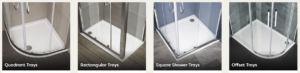
The majority of rectangular and square shower trays will be compatible with almost any shower enclosure, panel, screen or door. The enclosure will sit over the tray exactly to ensure a watertight fit.
Quadrant shower trays are designed to fit into a corner & have two straight-edged sides & a curved front. Offset quadrants are longer and have the curve at one end. Quadrant designs are great for smaller spaces. The tray must have the same radius as the enclosure so I suggest buying both from the same manufacturer to guarantee compatibility.
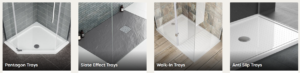
Pentagon shower trays also fit into corners but rather than a curve, it has five straight edges that can be of varying lengths
Bathroom size v shower tray size
Scale and proportion are two crucial elements of any design, especially in a small space such as a bathroom. It is important to choose the size and shape of shower to make sure it looks and feels right in the space.
In a smaller bathroom, a square corner shower or a quadrant or pentagon-shaped design are best. You could opt for a large rectangular shower in a bigger room.
The position of the shower is usually determined by the location of the utilities & existing plumbing & soil pipe. If there are wooden beams under the floor boards waste pipes can be laid between the beams but I would advise against drilling through beams because this will weaken the structure.
If the floor is solid the distance from the shower tray to the vertical soil pipe is important. Waste water has to be run at an angle so the further the tray is from the soil pipe the deeper the floor has to be drilled.
Soil and waste pipes need to be on a downhill gradient. The fall or drop should be between 1/40 (1cm down for every 40cm across) and 1/110.
It is also important to think about head height, sloping ceilings, windows and anything else that will encroach on the shower.
Bespoke options are available at extra cost & most manufacturers offer them but they will also require a bespoke surround or glass.
What are shower trays made of?
Acrylic and stone resin are the most common materials. Acrylic trays are lightweight but stone resin is a more solid compound which makes them more durable & resistant.
Stone resin trays have a heavy, solid-core capped in plastic that, once installed correctly, is less likely to leak due to its rigidity.
Acrylic shower trays tend to be only available in a gloss white finish so they lack a bespoke finish. Stone resin comes in various colours and textured finishes, such as slate, providing different options.
Fully plastic trays are not recommended as they flex which can create issues such as cracked grouting on the surrounding tiles and possible leaks.
A less common & more expensive option is an enamelled steel shower tray which is very strong and long-lasting. They can be customised in terms of colour, shape & size. If money is no object many opt for enamelled titanium steel which comes with a lifetime guarantee.
What are the safety issues to consider?
The main issue to consider is who is going to be using the shower. An older person would want to avoid trip hazards & prefer a non-slip surface. A young family might prefer a raised tray.
Shower trays have to deal with soap, shower gels and shampoos, which increase the risk of slipping, so you might just want to buy a non slip mat as anti-slip shower trays require more cleaning because dirt tends to get stuck on the rougher surface.
What about the installation?
Ideally it is best to use an expert bathroom installer but if budget is important & you are refurbishing to make a profit, it is perfectly possible to do it yourself.
The first step is to make sure the subfloor under the tray is solid. On a wooden floor, floorboards will have to be lifted to install the new pipework & fixed back securely. The tray should be installed onto plywood, not directly onto floorboards.
We advise using a large rubber seal or flexible upstand that sticks to the sides of the tray that sit next to the wall before silicone is applied to create a waterproof seal. It is worth purchasing an additional corner and edge sealing kit if the shower tray manufacturer offers one, for extra protection.
Many professional installers opt for fibre reinforced polystyrene construction boards for walls & floors instead of the ‘water-resistant’ plasterboards available.
Nowadays there are many instruction videos online.
Will you have a go or will you employ as expert?
Do let me know how you get on 😊


